Running a decision
An expert answers your question with three numbers instead of one. That is the whole idea, and everything on this page follows from it.
Why three numbers
Ask someone for a budget figure and they will give you one, because you asked for one. Ask them how confident they are and they will tell you something quite different: "around sixty, but it could be forty, and I would not argue with eighty."
The second answer is the true one. The first threw away the part that matters, which is the width. An expert who says 60 with a range of 40 to 80 and an expert who says 60 with a range of 58 to 62 have said different things, and a method that averages single numbers cannot hear the difference.
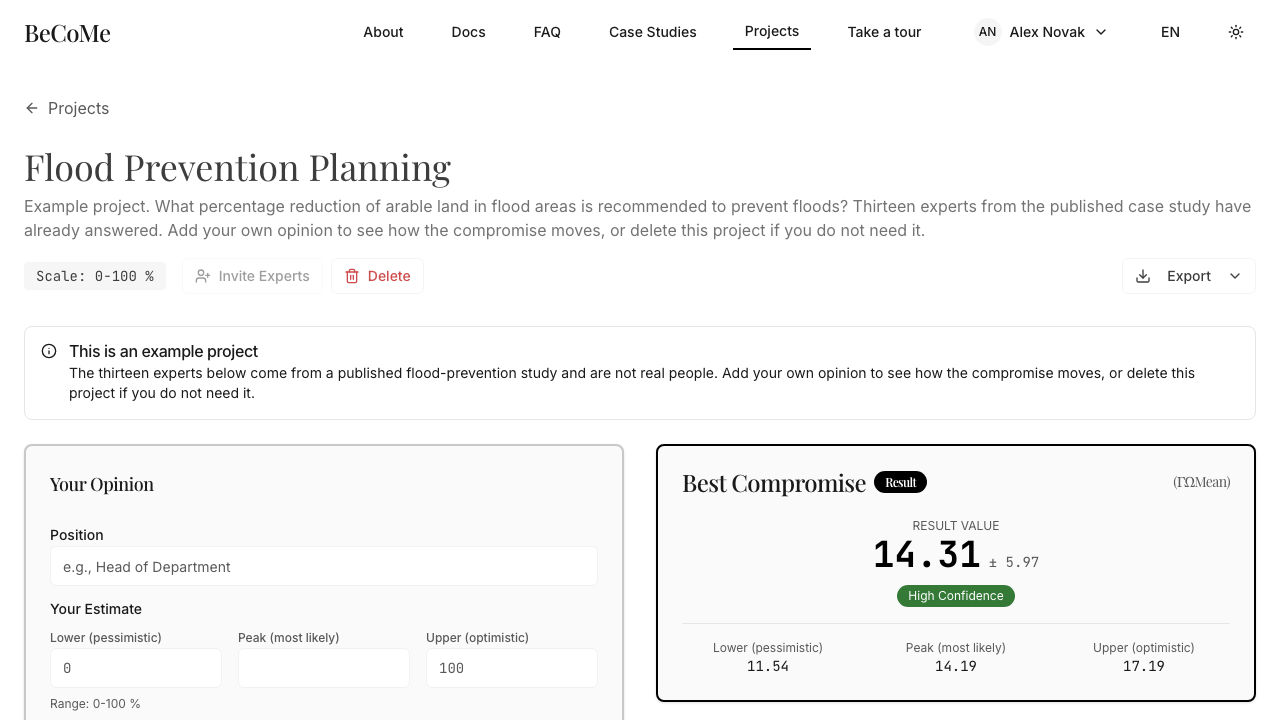
An opinion here has three components. The lower bound is the pessimistic end of what is
realistic, the peak is the single most likely value, and the upper bound is the optimistic
end. They must satisfy lower ≤ peak ≤ upper, and the form will refuse anything else.
The three ways to answer
A fuzzy triangular number is the normal case, and the one to reach for by default. Enter three
different values: (40, 60, 80) says "sixty, and I would accept anything from forty to eighty".
Widening your range does not weaken your vote, which is worth saying because most people assume the opposite. Take a panel of four and vary only the fourth opinion's width, keeping its peak at 60:
| Fourth opinion | Compromise | Centroid |
|---|---|---|
(58, 60, 62) |
(38.50, 47.50, 56.50) |
47.50 |
(40, 60, 80) |
(33.75, 47.50, 61.25) |
47.50 |
(20, 60, 100) |
(26.25, 47.50, 68.75) |
47.50 |
Here the compromise gets wider and its centroid stays at 47.50. That holds in general: when you move your lower bound down and your upper bound up by the same amount and keep the peak, the centroid of the compromise does not move. The centroid is the center of gravity of the triangle, as defined in reading the result. The peak of the compromise can shift, and the compromise can even get narrower, only when two opinions have exactly the same centroid. An honest range makes the group's uncertainty visible instead of hiding it. So state the range you actually believe. You are not spending influence by admitting doubt.
A crisp number is for the expert who is genuinely certain. Enter the same value three times:
(50, 50, 50). It is a triangle with no width, and the method treats it as one. Do not use it to
mean "I do not want to think about the range". A false certainty carries more weight than it has
earned.
An agreement answer is what the method offers for "should we" questions instead of "how much" ones, on a scale of 0 to 100 with no unit. It is described under reading the result, and it is not usable yet: the create form will not make such a project. Everything above applies to the quantities you can actually ask about today.
When the result appears
As soon as there is something to compute. The result updates every time an opinion arrives, so a half-answered panel gives a real answer for the experts who have answered so far.
That is worth using rather than waiting out. If the compromise swings hard when the fourth expert answers, you have learned something about your panel that the final number will hide.
Next: reading the result.